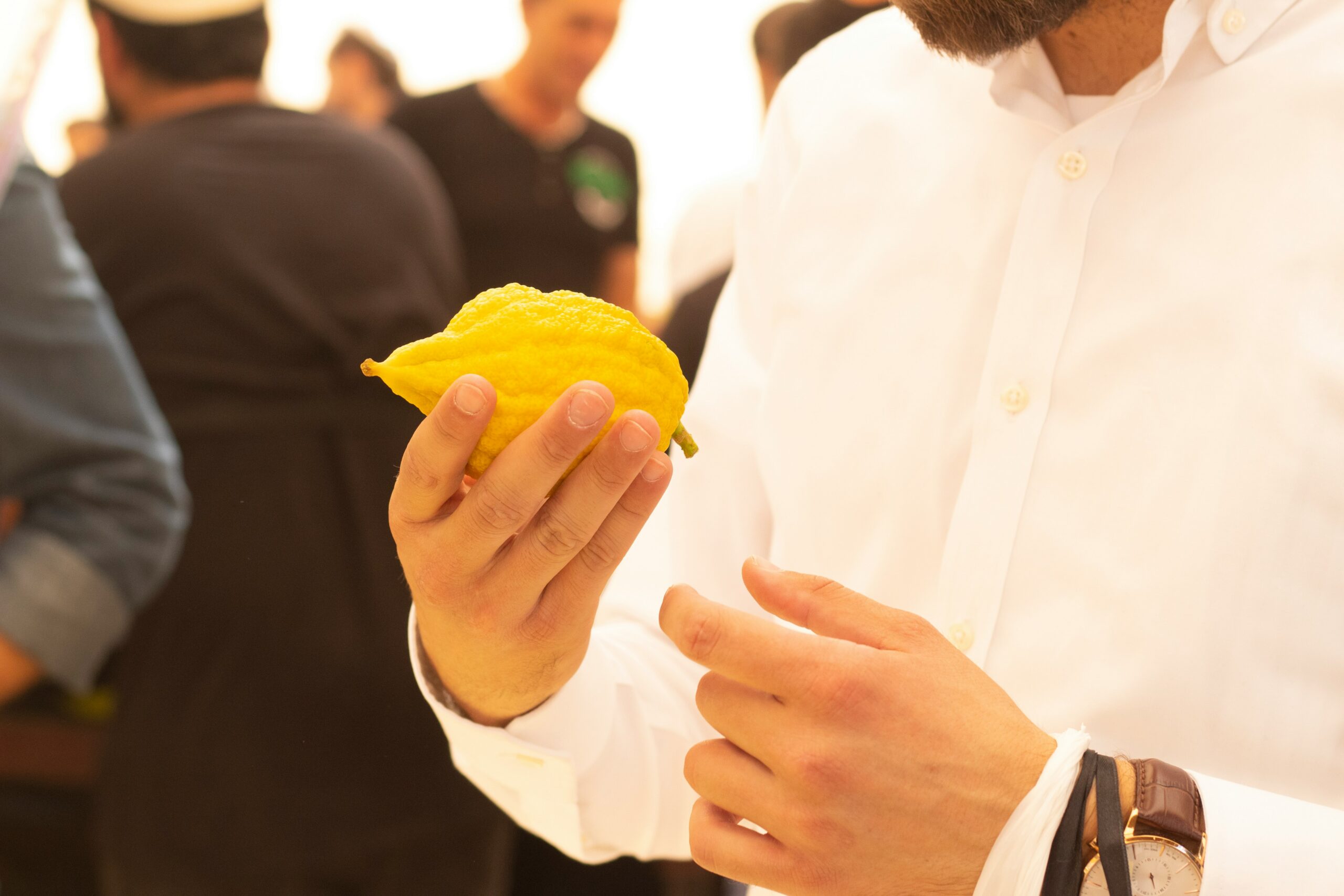
CHAI ON TORAH – On today’s festive episode we uncover the eternal depth and beauty of the mystical Yonif of Sukkos, where HaShem gives us a glimpse of how life truly works for one week out of the year. We leave our gates and security codes and safe rooms and we dwell outside under the stars seemingly vulnerable to the elements. What we’re supposed to glean from this mitzvah is there is no difference between being in the Sukkah and being in our homes in seemingly protected comfort. Hashem alone controls the world, we are as safe or as in danger as He wants us to be – we of course just have to do our hishdatlus. The four species we wave on Sukkos symbolize the 4 types of Jews, with the Esrog being the most famous. It was the only tree of Hashem’s creation that obeyed His original command, and we’ll uncover all of the mysterious aspects of the Arba Minim as well.
Sukkot, known as the Season of Our Joy, is far more than a historical commemoration of the wilderness wandering. In Torah Judaism, it represents the ultimate fusion of physical existence and spiritual reality, serving as a prophetic blueprint for the final redemption. The deeper layers of the holiday reveal a profound spiritual psychology through the mitzvah of the Sukkah, a roadmap for Jewish unity through the Arba Minim, and a cosmic vision of global transformation through its connection to the war of Gog and Magog.
The Sukkah and the Paradox of Security
The Sukkah is a unique mitzvah because it encompasses a person entirely. When a person walks into the Sukkah, their whole body, clothing, and everyday activities are elevated into a spiritual act. It represents the concept of the Clouds of Glory that surrounded the Jewish people in the desert, acting as a manifestation of divine protection.
Deeply, the Sukkah teaches the ultimate lesson in trust. By leaving a sturdy, permanent home to reside in a fragile, temporary hut with a roof made of detached organic material, a person strips away the illusion of physical security. The Sukkah demonstrates that material structures do not grant safety; rather, true stability comes from aligning oneself with divine providence. It represents a state of being where a person is fully exposed to the elements yet completely secure in the knowledge of a higher protection. It is a return to a state of spiritual purity immediately following Yom Kippur, where physical reality becomes a transparent garment for godliness.
The Arba Minim and the Four Archetypes of Unity
The Arba Minim, or Four Kinds, represent four distinct spiritual profiles within the Jewish nation, defined by two qualities: taste, which represents internal Torah wisdom, and smell, which represents good deeds and actions that impact the outer world.
The Etrog possesses both a pleasant taste and a pleasant aroma. It represents the complete individual who is dedicated to rigorous Torah study and is simultaneously active in acts of kindness and community service.
The Lulav, from the date palm, bears fruit that has taste but no smell. This represents the scholar who possesses deep internal intellectual knowledge and wisdom but lacks outward-facing actions or active community involvement.
The Hadas, or myrtle branch, has a beautiful fragrance but no taste. This represents the individual who may not have the capacity or opportunity for deep Torah scholarship but whose life is defined by active benevolence, integrity, and good deeds.
The Arava, or willow branch, has neither taste nor smell. This represents the individual who is distant from both formal Torah knowledge and active communal or religious engagement.
The mitzvah of the Arba Minim cannot be fulfilled unless all four types are bound together and held as one. This teaches that true national holiness and divine favor cannot rest on a fragmented community. The elite scholar requires the raw vitality of the simple deed-doer, and those who are distant must be included to make the community complete. Binding them together elevates all four, demonstrating that every individual is an indispensable component of the ultimate divine plan.
Sukkot and the War of Gog and Magog
The prophetic readings for Sukkot, specifically the Haftarah from the book of Zechariah and aspects of Ezekiel, link the holiday directly to the ultimate global conflict known as the War of Gog and Magog. This final confrontation is not merely a geopolitical clash, but a cosmic spiritual sorting process.
The connection lies in the underlying theme of Sukkot: the universal recognition of absolute truth. The ideology of Gog and Magog represents the pinnacle of human arrogance, a worldview that asserts human dominance, material power, and the denial of a higher moral authority. This worldview seeks to dismantle the spiritual mission of the Jewish people, who testify to a higher purpose in creation.
The climax of this war takes place during the season of Sukkot to mirror the ultimate transformation of the world. Just as the Jewish people invite the nations of the world into the spiritual abundance of the Temple through the seventy bullocks offered during the festival, the war of Gog and Magog represents the violent shattering of illusions for those nations who refuse to recognize that material power is secondary to spiritual truth.
Following the defeat of these forces, the surviving nations of the world will make an annual pilgrimage to Jerusalem specifically on the festival of Sukkot. They will do this because the core lesson of the Sukkah will finally become universally obvious: that all human empires, military might, and technological achievements are merely temporary huts, and that the only enduring reality is the divine presence. The holiday concludes the process of individual redemption that began on Rosh Hashanah and scales it up to a global, cosmic redemption.
I am humbly asking for your generous help supporting this noble Torah foundation; please consider us for a tax deductible donation at the link below…help me elevate the Jewish nation one precious soul at a time!
https://causematch.com/chaiontorah
https://a.co/d/0haLjSuq – My book COCAINE TO AMEN