
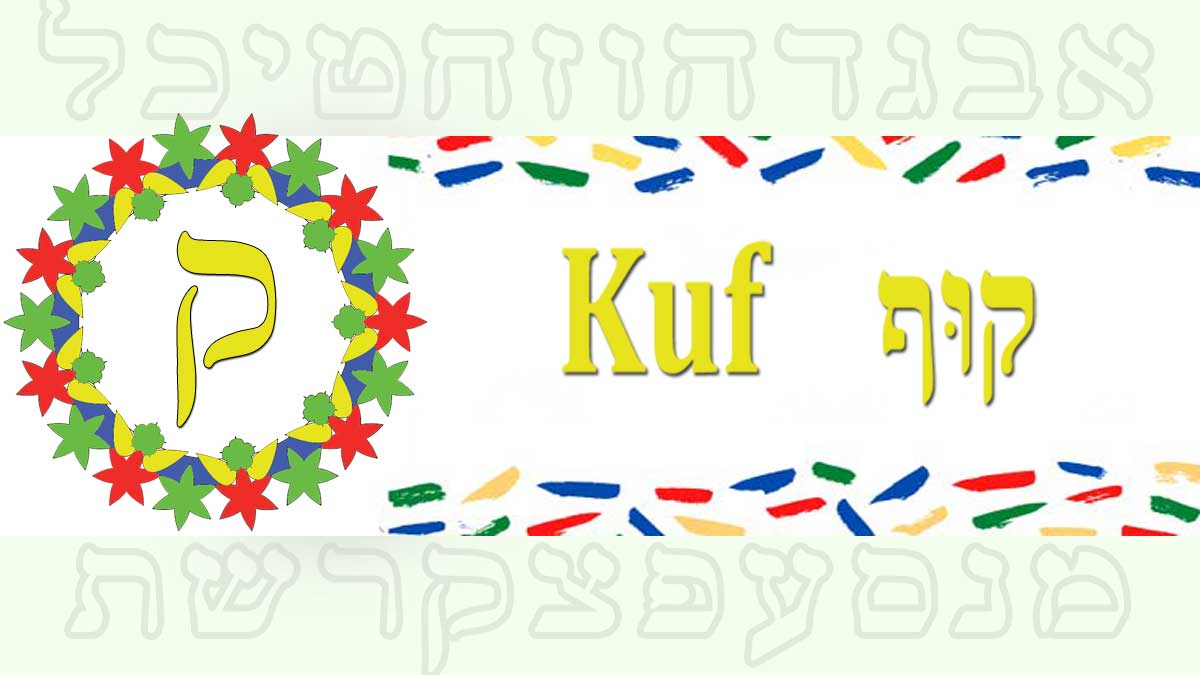
HEBREW LETTER SERIES – This episode is the twenty-second of 23 fascinating episodes on the 22 Hebrew letters and all the final letters. Today we shine light on the most interestingly shaped letter of them all, the KUF. What makes this letter so unique is the part of it which dips below the baseline, alluding to falling spiritually. However, it’s the first letter of the world Kedusha (holiness), so the duality of the the Kuf looms large. What will shock people the most is not just that the letter means monkey, but how so much of the meaning behind the Kuf does as well This series will illuminate the viewer, and perhaps no Hebrew letter represents the highs and lows we endure in life, yet triumph in the end, more than the beloved Kuf!
The Hebrew letter Kuf, also written as Qof, is the nineteenth letter of the Hebrew alphabet. It possesses deep spiritual significance, unique structural design, and complex mystical meanings within Jewish esoteric tradition and Kabbalah.
Shape and Structure
The letter Kuf is unique because it is the only letter in the Hebrew alphabet that extends below the baseline while not being a final letter, or Sofit. It is composed of two distinct components that do not touch. The left component is a curved line resembling the letter Resh or a roof with a side wall. The right component is a long, vertical line resembling a Vav or a drop line that descends below the structural baseline. The space between these two elements is a crucial aspect of its shape. Mystically, this separation represents a narrow opening or a gate. The left portion symbolizes holiness and structure, while the descending leg reaches down into the lower realms. This structural duality indicates a bridge between higher spiritual dimensions and the lower physical world.
Meaning and Etymology
The word Kuf literally translates to monkey in modern Hebrew, which carries a specific kabbalistic lesson regarding the nature of the physical world. Just as a monkey mimics human actions without understanding their true essence, the material world can mimic spiritual reality in a superficial or hollow way. Historically, the ancient pictograph for Kuf resembled the eye of a needle or the back of a head. This reflects the concept of looking behind the surface of reality to find the hidden divine spark. Additionally, Kuf is intrinsically connected to the word Kadosh, which means holy or sanctified. It represents the potential to elevate the mundane into something sacred.
Gematria and Numerical Value
In Hebrew numerology, known as Gematria, Kuf has the numerical value of 100. The number 100 represents completion, perfection, and the full manifestation of a cycle. It is ten times ten, signifying a complete integration of the ten spiritual emanations, or Sefirot, across multiple planes of existence. Abraham was one hundred years old when Isaac was born, representing a breakthrough beyond natural limitations into miraculous reality. Daily Jewish liturgy also encourages the recitation of one hundred blessings each day to draw divine light into every aspect of life. Therefore, the number 100 embodies the concept of a complete vessel ready to receive total spiritual fulfillment.
Spiritual Holiness
In the realm of spiritual holiness, Kuf represents the ultimate power of transformation and transformation through descent. Because its leg drops below the line, it signifies the divine ability to reach into the darkest, lowest, or most broken places of creation to rescue sparks of holiness. This process is known in Kabbalah as Birur Nitzotzot, or the gathering of the divine sparks. The gap between the two components of the letter serves as an open door for repentance, meaning that no matter how far an individual or a situation has fallen, there is always a path back to the source. It teaches that true holiness is not achieved by avoiding the lower realms, but by descending into them to elevate and sanctify them.
Aesthetic Beauty
The visual beauty of Kuf lies in its asymmetrical balance and tension. The floating left canopy creates a sense of shelter and stability, while the detached, plunging right leg introduces a dynamic vertical movement. This creates a striking visual contrast between holding ground and reaching downward. In traditional Torah scroll calligraphy, known as Stam, the roof of the Kuf is adorned with specific crowns, or Tagin, which add an intricate, regal elegance to its form. The intentional negative space between the two strokes gives the letter a breathing quality, reminding the viewer that what is unwritten or unseen is just as vital as what is tangible.
I am humbly asking for your generous help supporting this noble Torah foundation; please consider us for a tax deductible donation at the link below…help me elevate the Jewish nation one precious soul at a time! https://causematch.com/chaiontorah
https://a.co/d/0haLjSuq – My book COCAINE TO AMEN
Leave a Reply