
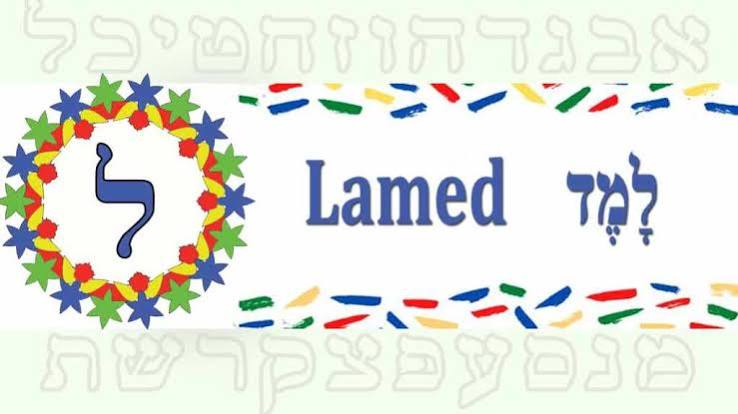
Introduction to Lamed
Lamed is the twelfth letter of the Hebrew alphabet. It occupies the exact central position among the twenty-two foundational letters. This central placement makes it the literal heart of the Hebrew alphabet. In phonetic classification, Lamed is a lingual consonant. It is pronounced like the English letter L. It is unique because it is the tallest letter in the Hebrew alphabet. It stands out visually because its upper arm extends far above the top line of all other letters.
The Shape and Visual Structure
The physical form of Lamed is highly symbolic. Scribes describe its shape as a combination of two other Hebrew letters. The base is the letter Vav, which represents a straight vertical conduit or a hook. Atop this base sits the letter Chaf, which represents a cupped hand or vessel. Together, they create a form resembling a shepherd’s crook or a cattle prod. The most defining feature of Lamed is its upper vertical extension. This tower-like arm is called the “Vav of Lamed.” It pierces the upper boundary of writing, stretching toward the heavens. It acts like an antenna drawing spiritual energy down into the lower realms.
The Meaning and Etymology
The word Lamed is both a noun and a verb. As a root verb, it carries a dual meaning: to teach and to learn. This dual nature shows that true learning and teaching are interconnected parts of the same continuous process. The ancient pictograph for Lamed was a shepherd’s staff. A shepherd uses this staff to guide, direct, and protect his flock. Therefore, the letter embodies the concepts of guidance, direction, purpose, and movement. It represents the force that drives an individual out of complacency and toward purposeful action.
The Beauty and Aesthetic Symmetry
Aesthetically, Lamed brings a unique kinetic energy to Hebrew calligraphy. Most Hebrew letters are square and earthbound, remaining within a uniform horizontal grid. Lamed breaks this pattern by soaring upward. This design provides visual relief and a sense of vertical movement to the text. It serves as an asymmetric anchor that balances the visual weight of shorter letters. When placed in the center of a word, it creates a striking focal point that draws the eye naturally toward its elevated crown.
The Gematria and Numerical Value
In Hebrew numerology, known as Gematria, every letter has a specific numerical value. The value of Lamed is thirty. The number thirty is traditionally associated with authority, leadership, and mature wisdom. In ancient Israel, a person achieved the full maturity required for public service or spiritual leadership at age thirty. Furthermore, if you analyze the letters that form the word Lamed itself—Lamed (30), Mem (40), and Dalet (4)—the total sum is seventy-four. This number reduces to eleven, which symbolizes moving beyond a complete cycle of ten into new spiritual territory.
The Spiritual Holiness and Cosmic Significance
Lamed possesses profound holiness within Jewish mysticism and Kabbalah. It represents the concept of “the heart that understands wisdom.” The final letters of the three sections of the Hebrew Bible—Torah, Prophets, and Writings—together spell the word Lamed, signifying the ultimate purpose of scripture is spiritual education. It is also the tallest letter because it represents the yearning of the human soul to transcend physical limitations and connect with the Divine. When combined with the letter Aleph, it forms the word “El,” one of the sacred names of God, illustrating its foundational role in divine architecture.
I am humbly asking for your generous help supporting this noble Torah foundation; please consider us for a tax deductible donation at the link below…help me elevate the Jewish nation one precious soul at a time! https://causematch.com/chaiontorah
https://a.co/d/0haLjSuq – My book COCAINE TO AMEN
Leave a Reply