
Introduction
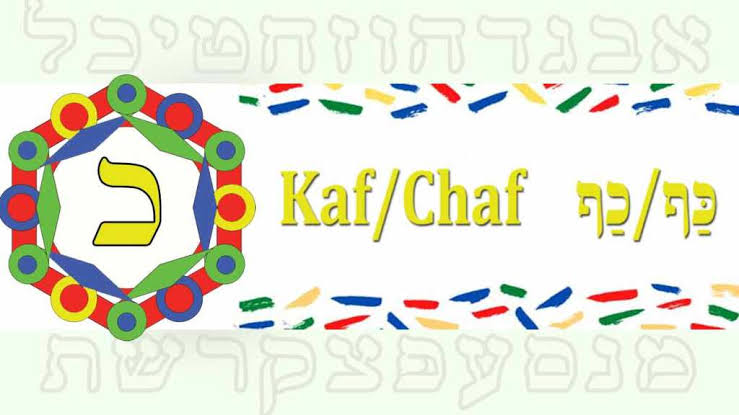
The letter Kaf is the eleventh letter of the Hebrew alphabet. It represents the numerical value of twenty. In the physical form of writing, it is one of the five Hebrew letters that changes its shape when it appears at the very end of a word. When it is placed at the end of a word, it is called Kaf Sofit. In speech, Kaf can make two different sounds depending on the presence of a dot in its center known as a dagesh. With the dot, it makes a hard K sound. Without the dot, it makes a soft, guttural breath sound similar to the CH in the word Bach.
Shape
The physical form of the standard Kaf resembles a rounded, three-sided enclosure that is open on the left side. It looks like a bent pipe or a cupped human hand viewed from the side. This shape suggests a vessel designed to contain or hold something. The top and bottom horizontal lines represent heaven and earth, while the vertical line connects them. When written as Kaf Sofit at the end of a word, the bottom horizontal line drops straight down. This creates a long vertical line that extends below the standard baseline of writing, symbolizing energy flowing downward into the physical world.
Meaning
The literal meaning of the word Kaf in Hebrew is the palm of a hand or a sole of a foot. It also translates to a spoon or a shallow bowl. All of these objects share a common function which is to hold, measure, scoop, or contain. While the previous letter Yod represents the hand as a closed fist or an active pointer of energy, Kaf represents the hand open and ready to receive or to give. It symbolizes the concept of a container, the act of shaping raw material, and the ability to manifest an abstract idea into a tangible reality.
Beauty
The aesthetic beauty of Kaf lies in its graceful, sweeping curves and its structural balance. It represents the perfect equilibrium between being open and being closed. It curves to protect what is inside but remains open on one side to interact with the rest of the word. Its visual architecture conveys a sense of humility because it appears to be bending or bowing down. The contrast between the standard curved Kaf and the straight, elongated Kaf Sofit provides a visually dramatic shift that gives Hebrew text a dynamic rhythm and a sense of resolution at the end of words.
Gematria
In the system of Hebrew numerology known as Gematria, the standard letter Kaf has the numerical value of 20. The number 20 is associated with the completion of a cycle and the readiness for action. When Kaf is written as a final letter at the end of a word, its value can sometimes be calculated as 500 in the extended Gematria system. The number 20 connects Kaf directly to the concept of dualities working together, as it is twice the value of Yod which equals 10. This numerical relationship reinforces the idea that Kaf is the mechanism that doubles or mirrors spiritual energy in the physical world.
Spiritual Holiness
Spiritually, Kaf is known as the letter of actualization and potential. It represents the divine capacity to mold and form creation. Kabbalistic tradition teaches that Kaf symbolizes the Keter, which is the highest crown of spiritual emanation. The curve of the letter resembles a crown placed upon a head. It signifies the bowing of one’s ego to align with a higher divine will. Because it means the palm of the hand, it represents the spiritual tool of blessing, charity, and the physical manifestation of spiritual thoughts into concrete, holy deeds.
I am humbly asking for your generous help supporting this noble Torah foundation; please consider us for a tax deductible donation at the link below…help me elevate the Jewish nation one precious soul at a time! https://causematch.com/chaiontorah
https://a.co/d/0haLjSuq – My book COCAINE TO AMEN
Leave a Reply