INTRODUCTION
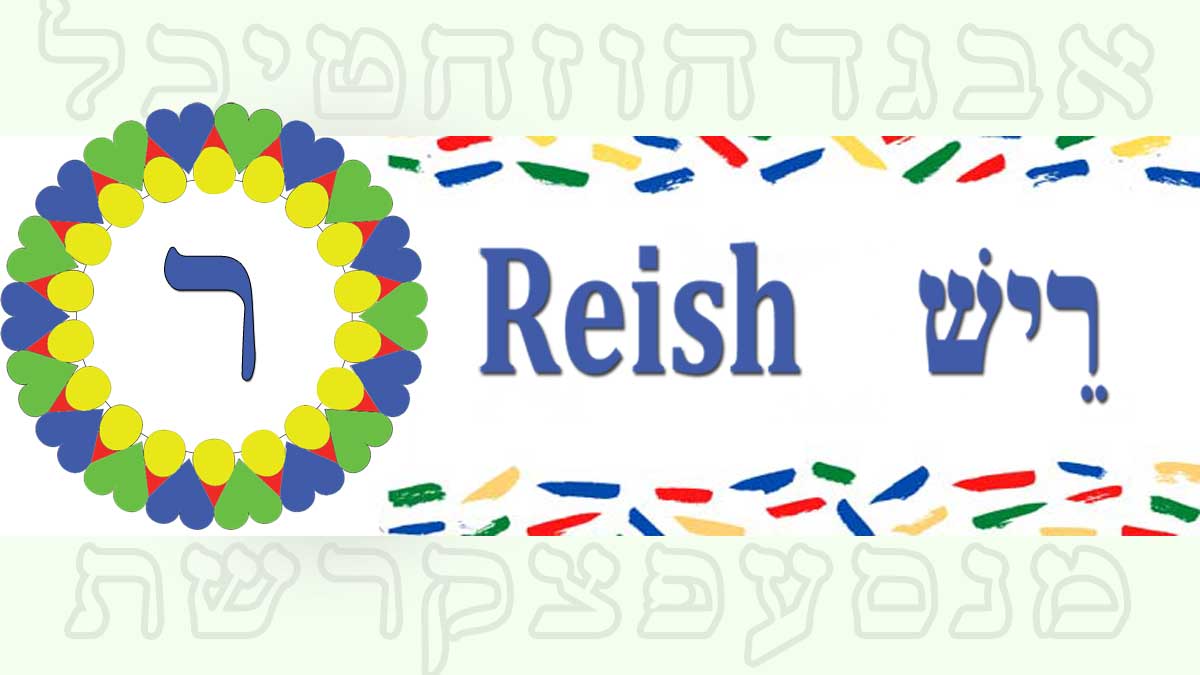
The letter Reish is the twentieth letter of the Hebrew alphabet. It possesses the numerical value of two hundred. In the Hebrew script, it is written as a simple, single stroke that bends at a right angle, resembling a backward letter ‘P’ without the bottom closure or an inverted ‘L’. It represents the ‘R’ sound, which is produced deep in the throat or with the tongue in traditional Hebrew pronunciation. It occupies a critical position near the end of the alphabet, serving as a transitional element before the final cosmic forces of the letters Shin and Tav.
SHAPE
Visually, Reish is defined by its simplicity and its sharp corner. It consists of a horizontal roof and a vertical leg dropping down from the right side. The shape closely resembles the letter Dalet, which is the fourth Hebrew letter. However, a critical spiritual distinction lies in the corner. While Dalet has a small extension or point protruding from its top-right corner, Reish has a completely rounded, smooth corner. This absence of the point represents a lack of stability and substance. The shape is also said to look like a human head bent forward in prayer, submission, or poverty.
MEANING
The literal meaning of the word Reish is derived from the Aramaic word for ‘head’ or ‘chief’, which corresponds to the Hebrew word ‘Rosh’. It signifies leadership, beginnings, and the highest point of a structure or entity. Paradoxically, the letter is also intrinsically linked to the Hebrew word ‘Rash’, which means a poor person or someone experiencing scarcity. This dual meaning creates a profound linguistic tension. Reish represents both the highest pinnacle of authority and intellect, and the lowest state of human destitution and emptiness.
BEAUTY
The aesthetic and philosophical beauty of Reish lies in its minimalism and its relationship to movement. It represents the concept of constant change and flow, as its rounded corner allows energy to pass through without being caught by a defined point. Its beauty is found in its humility. By mimicking a bowed head, it illustrates the grace of bending before a higher power. It also demonstrates structural elegance by showing how the slightest alteration in form—the rounding of a corner compared to a Dalet—can completely transform the definition, energy, and impact of a symbol.
GEMATRIA
The gematria, or numerical value, of Reish is 200. In Hebrew numerology, the number 200 represents a state of insufficiency or a baseline of basic survival that lacks true spiritual wealth. In ancient monetary terms, two hundred zuz was considered the minimum amount of money a poor person needed to survive for a year without being legally allowed to collect charity. Therefore, the number 200 reinforces the theme of poverty and emptiness. It signifies a vessel that is structurally complete but remains completely hollow, waiting to be filled by divine light or external abundance.
SPIRITUAL HOLINESS
In spiritual traditions, Reish represents the human ego and the material world when separated from the Divine. Because it lacks the distinctive point of the Dalet—which represents God—Reish symbolizes the illusion of independence from the Creator. When a person removes God from their life, they fall into spiritual poverty, turning the Dalet into a Reish. Conversely, the holiness of Reish is realized through the process of ‘Teshuvah’ or return. When the bowed head of the Reish submits to higher spiritual truth, it becomes the ‘Rosh’ or the holy head, transforming emptiness into a crown of divine wisdom.
I am humbly asking for your generous help supporting this noble Torah foundation; please consider us for a tax deductible donation at the link below…help me elevate the Jewish nation one precious soul at a time! https://causematch.com/chaiontorah
https://a.co/d/0haLjSuq – My book COCAINE TO AMEN
Leave a Reply